Before the surface is covered
Spray Foam Application Conditions and Substrate Readiness
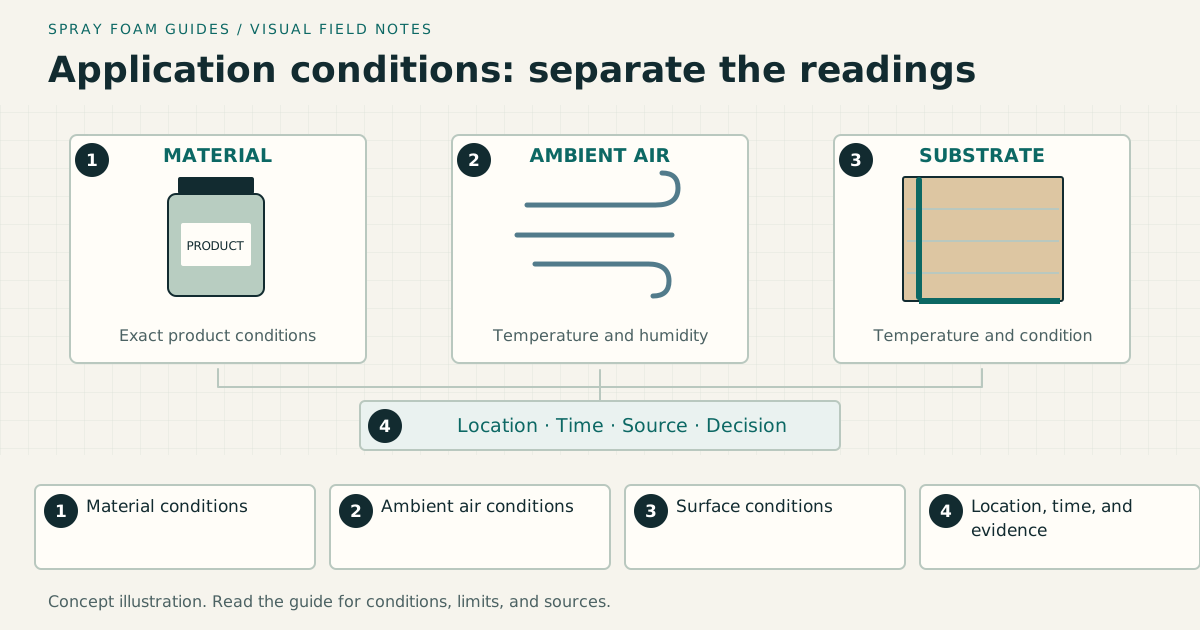
Spray foam readiness depends on the product, the surface receiving it, and the conditions at the time of work. A useful record separates air, material, and surface measurements, identifies unknowns, and shows who accepted each area before it was covered.
On this page
The short answer
A comfortable room temperature or dry-looking surface does not establish application readiness. Have the responsible contractor match the exact formulation and substrate to current instructions, document meaningful measurements, and hold unresolved areas for assessment. Repeat the relevant checks when conditions change.
This answer changes when…
- The exact foam formulation and current application instructions are identified
- Substrate condition and compatibility can be assessed through safe, authorized access
- Measurements have locations, times, units, methods, and applicable acceptance criteria
- Leaks, uncertain coatings, and unreliable readings are resolved before concealment
- A responsible contractor controls application, reinspection, and access decisions
Dotted terms have plain-language definitions. Browse the glossary ↗
What makes a surface ready for spray foam?
Readiness means the responsible contractor has checked the actual surface and conditions against the requirements for the exact product and proposed assembly. It is a decision about a particular area at a particular time. A weather forecast, delivery receipt, or photograph of clean framing cannot establish it alone.
This guide helps owners understand the record and helps project teams define the questions. Application, equipment operation, chemical handling, and acceptance of questionable substrates belong to qualified personnel. Start with reading SDSs, TDSs, and evaluation reports if the document package is incomplete.
DOE’s Building America roof guide identifies substrate moisture, temperature, lift thickness, component ratios, and material handling as quality-control concerns. Its roof examples do not establish universal limits for other products or assemblies.
Keep the different temperatures separate
The word “temperature” needs an object and a location. Give each of these its own field:
- Storage conditions: The history of the unopened or partly used components, including known departures from the manufacturer’s requirements.
- Material conditions during use: The condition of each component when processed. A reading from the outside of a container should identify that measurement rather than be labeled as an internal material reading.
- Ambient conditions: The air in the work area, which may differ from the occupied room or outside weather station.
- Substrate conditions: The surface receiving foam, including colder edges or areas affected by sun.
- Equipment settings and observations: The applicator’s processing record, kept separate from measurements of air and surfaces.
The retrieved JM Corbond IV installation guide illustrates these distinctions with separate storage, drum, equipment, and surface entries. It also describes different formulation profiles. Its values are specific to that system; confirm the applicable current instructions with the manufacturer.
A cured product’s service-temperature rating is another category. It is not a permitted application range. If a project spreadsheet has just one temperature box, expand it before anyone relies on it.
Separate surface water, humidity, and moisture inside a material
Rainwater, dew, frost, and water held within wood raise different questions. An air relative-humidity reading does not measure wood moisture content. A surface that appears dry may still need material-specific moisture assessment.
Dew point describes the temperature at which the air reaches saturation. A sufficiently cold surface can therefore develop condensation even when the room feels warm. PNNL’s moisture definitions explain the relationship. Record the relevant local air conditions and surface temperature together; use any required dew-point separation from the exact application instructions, with its units and measurement basis confirmed.
Do not substitute a generic internet moisture percentage for the acceptance criterion. Identify whether a document addresses wood, concrete, surface water, or something else. Record leak history and unresolved staining separately from today’s readings. A repair and its drying assessment should be traceable before insulation conceals the area. See moisture, condensation, and drying.
Know what the instrument actually measured
An infrared thermometer reads an area of surface. A laser, where provided, is an aiming aid, and the measured area changes with distance. Reflective surfaces and instrument settings can make interpretation difficult. Fluke’s measurement guidance explains these limitations. Record the instrument and method; have the operator resolve questionable readings using an appropriate method for that surface.
Electrical wood-moisture meters estimate moisture through electrical properties. Species, temperature, preservatives, and the measuring method can affect results. FHWA’s technical explanation documents these issues in timber assessment. Its bridge guidance is not a spray foam acceptance specification.
The record should identify the material setting, relevant corrections, measurement locations, and limitations. Do not call an unidentified relative scale “percent moisture.” One accessible reading cannot establish the condition of every hidden area, and moisture measurement alone does not establish whether wood has decayed.
If uncertainty prevents a defensible comparison with the requirement, mark the result unresolved. Rounding a borderline reading into the acceptable range does not answer the question.
Confirm the surface and formulation together
“Open-cell” and “closed-cell” describe broad categories. They do not identify compatibility with every coating, membrane, treated panel, metal finish, or existing foam.
For example, the Icynene Ultra 50 TDS, revision June 30, 2025, identifies an open-cell formulation and separately addresses surface contamination, concrete condition, and application conditions. The JM guide linked above includes substrate and primer considerations for its closed-cell formulation. These documents illustrate questions to resolve; neither provides blanket permission to spray any material in its category.
Ask what foam will actually contact. A coated panel is not simply bare wood. Identify the coating or primer, its condition, and any required compatibility confirmation. Resolve dust, oil, loose material, or peeling finishes through the appropriate preparation scope before acceptance. Do not improvise sanding or stripping of unidentified old material; the pre-removal assessment guide covers the earlier investigation.
Worked example: turn a document into a decision
Consider a hypothetical wall project with exposed framing and some previously coated panels. The crew has the exact foam documents, but its first inspection note says only “room warm, surface dry.” No actual manufacturer limits or site measurements are invented in this example.
Using the Ultra 50 document as a reading exercise, the team separates component storage from processing conditions and locates the substrate requirements. It then asks whether the project record contains the corresponding evidence. The brief inspection note does not establish material conditions, local surface measurements, or coating compatibility.
The project lead creates two locations: framing area W1 and coated panel area W2. W1 needs the specified measurements and contractor assessment. W2 additionally needs identification and acceptance of the coating. Both remain unresolved until their missing evidence is supplied; one area’s outcome does not automatically cover the other.
The useful result is a list of missing decisions, not a guessed temperature setting. If instructions conflict, preserve both references and request manufacturer clarification. Do not combine the most permissive parts of different documents into a new specification.
This exercise does not select Ultra 50 for the job. The same record method can be applied to another system using that system’s own requirements.
Use a field record that another person can follow
The table below is a suggested project record, not a manufacturer form or an inspection certificate. Add measurements as separate rows when locations or times differ. Keep actual values and units alongside the corresponding requirement.
| Record field | What to enter |
|---|---|
| Area and time | Room, wall, roof slope, or bay ID; date and measurement time |
| Product identity | Exact formulation, component labels, lots, and linked instructions |
| Requirement | Parameter, applicable limit or condition, units, document revision, and page |
| Substrate | Material, coating or primer identity, visible condition, and repair history |
| Air and surface | Separate local air and surface readings; humidity and dew-point assessment where applicable |
| Material and equipment | Separate component-condition evidence and applicator processing record |
| Moisture evidence | Method, material setting, actual readings, and unresolved wetting concerns |
| Measurement quality | Instrument identification, relevant checks or corrections, access and method limitations |
| Decision | Accepted for a defined step, held, or awaiting clarification; reason and responsible person |
| Follow-up | Corrective action, recheck trigger, new evidence, and dated signoff |
Keep the original observation when a condition changes. A later acceptable reading should be a new entry, with the intervening action explained. Photographs help locate observations but cannot replace measurements or the responsible person’s judgment.
Plan for changing conditions and the next layer
Agree on recheck triggers before work starts: a different surface, a new work area, changing weather, interrupted conditioning, water exposure, or a return visit. The contractor should define monitoring and reassessment appropriate to the system. A morning check should not silently become approval for every later condition.
Application sequence also matters. The JM document includes substrate-dependent pass and cooling qualifications, illustrating why one generic lift rule is inadequate. Put these questions to the applicator:
- Which exact instructions govern each pass and the total build-up for this surface?
- What cooling or other conditions must be satisfied before another pass?
- What happens after a break or when returning to previously applied material?
- Does a planned coating or finish have its own preparation, timing, or acceptance requirements?
- Who records a deviation and obtains an accepted response before further work?
These are planning questions, not spraying instructions. Material conditioning and equipment changes must follow the applicable manufacturer and safety requirements. Improvised heating to reach a desired reading is not a resolution.
Cooling before another pass, tack-free appearance, trimming permission, full cure, and occupant return are separate milestones. EPA’s archived chemical-exposure guidance explains that foam can appear hardened while still curing. A cooling interval or tack-free surface does not establish full cure or authorize reoccupancy.
Assign acceptance, access, and handover responsibilities
Name the person who records conditions, the contractor who accepts application readiness, and any designer or specialist needed to resolve a concern. A signature should state what was checked and which area it covers. An owner’s acknowledgment of the schedule does not approve foam chemistry or release the contractor’s responsibilities.
For two-component application, site readiness includes arrangements for occupants, pets, and unprotected trades to leave, along with isolation and ventilation. EPA’s archived workplace guidance addresses this planning. Obtain exact-system return instructions before work begins; the ventilation and reentry guide explains the questions to resolve.
Keep substrate acceptance separate from permission to enter or occupy the building. A satisfactory surface measurement, foam appearance, or completed record cannot establish that exposure concerns are resolved.
At inspection and handover, request the location records, unresolved-item closures, manufacturer clarifications, and any later rechecks. The next contractor should be able to tell what was covered, what was verified beforehand, and which limitations remain.
Research & references
Sources used for this guide
- Unvented Conditioned Attic with Spray Foam Below the Roof DeckDOE Building America Solution Center · government guidance · United States · accessed 2026-09-05
- Moisture MetricsDOE Building America Solution Center · government guidance · Moisture definitions and vapor-pressure transport; no generic design target inferred · accessed 2026-09-06
- JM Corbond IV Closed-Cell Spray Polyurethane Foam Installation GuideJohns Manville · manufacturer document · United States; exact-system examples of separate condition fields and substrate-dependent requirements, not universal limits or confirmation of the latest revision · accessed 2026-09-06
- Icynene Ultra 50 Technical Data Sheet, revision June 30, 2025Huntsman Building Solutions · manufacturer document · United States; one open-cell formulation's condition distinctions, not blanket substrate approval or transferable application settings · accessed 2026-09-06
- How to Get Great Results with an Infrared ThermometerFluke · manufacturer document · United States English; infrared surface measurement limitations only, not a spray foam acceptance procedure or instrument recommendation · accessed 2026-09-06
- InfoTechnology: Bridge Moisture Content MeasurementU.S. Department of Transportation / Federal Highway Administration · government guidance · United States; timber moisture measurement principles and limitations, excluding bridge-specific thresholds, probe dimensions, and inspection prescriptions · accessed 2026-09-06
- Safer Workplace Practices for Spray Polyurethane Foam Installation (archived)U.S. Environmental Protection Agency · government guidance · United States; archived guidance · accessed 2026-09-05
- Potential Chemical Exposures From Spray Polyurethane Foam (archived)U.S. Environmental Protection Agency · government guidance · United States; archived guidance · accessed 2026-09-05
A citation supports a specific statement, not every possible assembly or local code interpretation.